Tuesday, 5 August 2008

Chess Reviews: 57

Fighting the Anti-King’s Indians
By IM Yelena Dembo
Everyman Chess

IM Dembo’s previous book examined the Grunfeld Defence. This companion volume (which, as such, could really have been entitled ‘Fighting the Anti-Grunfelds) sets out to show how to deal with the following White systems, all of which deny Black the chance of mainline Grunfeld and King’s Indian variations.

The Trompowsky
The Veresov
The Barry Attack
The London System
The Torre Attack
The Colle System
A Kingside Fianchetto vs. The King’s Indian
A Kingside Fianchetto vs. The Grunfeld
The Blackmar-Diemer Gambit
Various Second Moves
Fianchettoing against the English
The English King’s Indian


A lot of these systems make regular appearances in club chess and there’s no doubt that some preparation is required to obtain a comfortable game with Black.

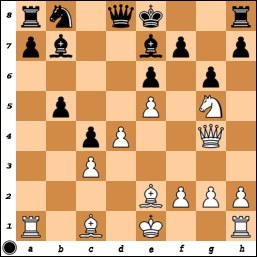
The first chapter deals with the (in)famous Trompowsky, an opening with a real cult following. 1 d4 Nf6 2 Bg5 c5 is analysed in depth; at 38 pages, this is the longest chapter of the book. One point of the second move is to allow the Queen speedy access to b6, logically trying to exploit the absence of the Bishop from White’s Queenside. The b2 pawn is often offered as a gambit and play becomes very sharp. A careful study of this chapter is essential and it’s probably the one which will come in most useful.

This is a position from one of the key lines - and it’s tricky stuff.


‘It requires great tactical mastery from White to succeed in winning the Queen
without shedding more material than a Rook if that’s at all possible.
Furthermore, after much analysis I believe that he can’t!’

Being armed with such analysis should turn 2...c5 into a welcome addition to any repertoire.

Some of the White options come off very poorly in the light of hard analysis. Anyone reading this book should be put off the likes of the Veresov and the Blackmar-Diemer Gambit for good.
I particularly liked the coverage of the London System, in which Black adopts an ambitious set-up with the unusual-looking …Be6. This is to stop the White Queen using the b3 square in response to a timely …Qb6. If she goes to the -file instead to defend b2 then a Black Rook coming to c8 should prove uncomfortable.

This is Black’s ideal set-up:


It’s highly reminiscent of a plan Korchnoy as White, in a Reti Opening, used in the mid-1980s, most famously in a very big match:


Korchnoy - Polugaevsky
USSR v Rest of the World

I’ve used the White system a few times but never thought of using it as an anti-London weapon. I will keep it mind for future encounters.

The Various Second Moves include odd-balls such as 2 e4 and 2 g4 as well as the more robust rarities 2 f4 and 2 g3. It is not accurate to credit GM Benko with 1 d4 Nf6 2 g3, based on his games at Curacao 1962, as he started those famous encounters with 1 g3, only committing centre pawns in accordance with Black’s reply.

After 1 d4 Nf6 2 f3, the recommended line of: 2...d5 3 e4 c5!? 4 e5 Nfd7 5 c3 Nc6 6 Be3 e6 7 f4 turns it into a French Defence. That would suit me fine, but a lot of KID players won’t necessarily have any experiences of such positions and might end up disorientated. Having said that, 2 f3 isn’t likely to feature many times in anyone’s games.

There’s a problem for Grunfeld players, as pointed out in the chapter concerning ‘Fianchettoing against the English’. Black simply can’t get a game of choice against 1 Nf3 Nf6 2 c4 g6 3 Nc3 d5 when both 4 cxd5 Nxd5 5 Qa4+ and 4 Qa4+ are both frustrating.

However, those happy with a King’s Indian Defence should be content with 3...Bg7 4 e4 d6 when a main line looms.

‘I’m afraid that there is no simple or ideal solution for the Grunfeld player against 1 Nf3 Nf6 2 c4! The Grunfeld fanatic may be happy to further explore the variations I have supplied an overview of, but I would suggest instead treating the English as a serious opening in its right and devoting a decent amount of time to the study of its various branches.’

Help is at hand: the final chapter takes the English seriously and provides some interesting lines for Black to try.


Starting Out: The Modern
By GM Nigel Davies
Everyman Chess

Playing 1..g6 against virtually everything has a certain appeal, especially for a player with limited study time.

There are other tempting reasons for playing the Modern, as GM Davies points out:

‘It does not lead to clear and crisp positions, but to rather muddy sand complex strategic and tactical problems. It is this characteristic which makes it ideal for playing to with Black: there are not the clean forcing lines and early resolution of tension which characterize the majority of openings. The delayed confrontation of pieces also makes it less vulnerable to sharp opening analysis - it requires understanding rather than memory.’

The author used to rely very heavily on the Modern Defence and it served him very well. His ‘formerly secret notebooks’ are listed in the bibliography, making it quite clear from the outset that readers can expect expert material.

The variations are broken down into the following chapters:

The Austrian Attack and Other f2-f4 Lines
Bg5 Systems
Be3 and h2-h4 Systems
Bc4 Systems
g2-g3 Systems
The Classical 4 Nf3
Early c2-c3 Systems
The Averbakh System
The Lesser Averbakh
Other 1 d4 Lines
Flank Openings

I suspect club players are quite likely to face the Austrian Attack and the Be3 system (akin to the 150 Attack against the Pirc). Against the former, GM Davies advocates evolving the Black position into a Hippopotamus formation after, with the logic being restraint against the f4-f5 push and the realisation that any potentially weaker dark squares after the combination of …g6 with …d6 and …e6 won’t be so easy to get as White’s Queen’s Bishop is rather blocked by the f4 pawn.


This is the sort of position Black is aiming for. A break in the centre with …c7-c5 is on the cards. Black’s set-up here is certainly an easy one to remember.

4...a6 is the way to meet White’s attempt to play into a 150 Attack.


'Not many people like to play such moves, but behind its odd appearance lies a great deal of logic. Black wants to expand on the Queenside with the moves …Nd7, …b7-b5, …Bb7 and …c7-c5 and argues that he can attend to things like development later on. The move 4 Be3 is attuned more to attacking a castled King than one that is loitering I the centre!'

Indeed, White could be put off castling Queenside by the possibility of Black’s early …b7-b5 advance.

The illustrative are all very well-chosen, with GM Davies clearly showing that he likes to practice what he preaches; one game in particular stands out - a win against World Champion Anand.

‘Young Anand was evidently not happy with the outcome of this game and has since been dodging me by playing in category 18+ events.’

As usual for a book in the ‘Starting Out’ series, the text is replete with tips, warnings and notes.
30 ‘Test Positions’ provide the reader with a final work out before unleashing their newly-learned 1...g6 skills in tournament encounters.

Here’s the first one:

Arnason - Keene

All those who know GM Keene as ‘just’ an author should be aware that he played very fine chess and produced some very important games in the Modern and Pirc. Can you see how he demonstrated the strength of the Modern Bishop? It’s Black turn and after four more moves White resigned.

The index of variations is a very welcome feature, enabling readers to easily navigate and locate coverage of relevant variations.

This is an impressive addition to a very good range of books, providing a full repertoire for you to study and absorb in time for the new season.


Dangerous Weapons: The Benoni and Benko
By IM Richard Palliser, GM John Emms,
GM Chris Ward and GM Gawain Jones

Everyman Chess

The theme of fianchettoing Black’s King’s Bishop is continued is continued here, with 14 dangerous weapons from two of the sharpest possible openings. The four authors share the writing duties and it’s very encouraging to see four Benoni/Benko experts freely divulging their secrets.

There are seven weapons for each colour and they deal not only with the Modern Benoni and Benko Gambit, but also in related variations such as the Czech Benoni and Blumenfeld Gambit.

Even the rare Snake Benoni gets to rear its head, although the future looks bleak for the slippery customer: the chapter heading, ‘Killing the Snake’, makes things sound rather grim.
The Modern Benoni seems to be under pressure. Not only has ‘Epishin’s Deadly 8 Qe2’ ‘…become a real pain for 7...a6 supporters’ but White has an earlier alternative intended to give Black more headaches.

1 d4 Nf6 2 c4 c5 3 d5 e6 4 Nc3 exd5 5 cxd5 d6 6 Nf3 g6 7 Qa4+!?


The Queen check is more commonly tried after 7 Bf4 but the earlier excursion gives White some interesting options. For example, after 7 …Qd7 (as analysed ion the first illustrative game) White can take advantage of the clear path to the Kingside and swing across with 8 Qh4! when Benoni players will surely be feeling rather uncomfortable already at the prospect of a rapid Bh6.

This book is full of such thought-provoking material.

The insights of GM Jones (currently competing as the top seed in the British Championship) in his favourite Benko Gambit are especially valuable and there are three chapters of his thoughts on this popular opening.


Chapter 10 deals with ‘A Paradoxical Bishop Retreat’. In this typical Benko position, Black plays 11...Bc8. The idea is to head for the f5 square to hassle the Rook. A battle can now ensue over control for the critical square. Sometimes the Bishop even reroutes itself back to a6 after White has made concessions.

This is not a repertoire book, but it should be fairly easy to slip some of these dangerous ideas into an existing repertoire. The format of presentation works well. A game or two is given to grab the reader’s attention, followed by a deeper look at the actual theory. Then there’s a general conclusion, which doesn’t just say: ‘play this and win by force’ but gives genuinely helpful advice as to the validity of the suggested weapon. After all, some of the positions end up looking a shade on the wild and unusual side.

Here’s three randomly selected positions to give you a glimpse into a strange world:


There’s a lot of fun to be had with the lines presented in this book and the enthusiasm of the authors is clearly evident

As IM Palliser says in his preface:

‘All of the authors really enjoyed analysing the lines which they propose here, and are looking forward to employing them in their own games. I hope that readers will also enjoy getting to grips with the many dangerous lines featured here, before springing them on unsuspecting opponents!’

For further details of these and other Everyman products, please visit:

http://www.everymanchess.com/


Missed a review? Pop along to my archive:

http://marshtowers.blogspot.com/2007/12/chess-review-archive.html

Saturday, 2 August 2008

Chess Reviews: 56


The Chess Café Puzzle Book 2
By GM Carsten Müller

Russell Enterprises


I enjoyed the first Chess Café Puzzle Book (see review column 49), which dealt mainly with tactical possibilities. Book 2 tackles a more difficult area: chess strategy.

It's a difficult area to study. As well as finding a decent continuation in a given position, one must always be aware of 'mines on the road':

‘You cannot expect to solve the puzzles on positional grounds alone. Positional motifs do not exist in a vacuum and concrete calculation almost always plays a role.’

However, the art of calculation isn't the main skill being tested:

‘Always let your intuition be your guide in any given position.’

A plethora of ‘Motifs’ comes under scrutiny, namely:

Good and Bad Bishops
Domination
Outpost
Undermining
Opening the Position
Blockade
Improving Piece Placement
Prophylaxis
A Second Front
Counterplay
Positional Exchange Sacrifice
Simplification
Weaknesses
Weak Colour Complex


Each motif is fully explained with illustrative games and snippets, followed by a number of exercises to test the reader’s powers. Clues are slight; the reader is fully expected to put in a good deal of work in preparation for the ‘Tests’.

There’s no doubt about it - these puzzles are a lot trickier than straightforward tactical exercises. For most of us, our minds are chess-trained to seek out tactical blows and mating attacks and it’s not so easy to acclimatise to the tasks presented here.


Haba - Lechtynsky


For example, in this exercise (from the Prophylaxis section) the clue is:

‘It looks tough to break Black’s defences. But only one hit is necessary to make it collapse. Can you spot it?’

In other puzzle books we’d no doubt be looking at tactical shots until the brain found one to work. However, the correct strategical method to win from this position is indeed to apply a little prophylaxis and 27 h3! is the right move. There are sidelines in the book but the game didn’t last many more moves: 27 …Nb6 28 Qg4 Qd6 29 Rxf6! 1-0 Only one side has a secure back row, thanks to 27 h3!

It’s interesting to absorb the new problems and feel the brain start to make links. Just after seeing the answer to the exercise above, I had a sudden memory of the same move being played at the height of a very tactical battle:


Korchnoy - Spassky

The 1977-8 Candidates’ Final had it’s fame forged on the cauldron of controversy but there was an abundance of excellent chess too. Eschewing the tempting 31 Qb7 -which would have been met by 31 …Qa4! - Korchnoy had the presence of mind to opt for 31 h3!! and went on to win.
Once the lessons from the ‘Motifs’ have been fully absorbed, it’s time to move on to the second section of the book.

There are 20 Tests, each containing 16 positions. The author recommends solving them from the diagrams and allowing two hours per test. This may appear a little off-putting for those simply wanting a puzzle book to pass the time on a train journey or an instant fix of chess solving. However, there are great benefits for readers prepared to put in the necessary effort.

Here’s two sample test positions, taken at random:


Dautov - Bischoff
What is Black’s first priority?


I imagine I’m not alone in thinking Black should immediately begin to swing a Knight to the blockading square on d6. However, White has a threat on the Queenside - 16 a5 must be stopped, so Bischoff played the correct 16 …a5!


Nikolic - Kramnik
White’s minority attack has started. What to do about it?

Kramnik played 14 …b5!, swung a Knight to c4 to mask the c-file and went on to win in 35 moves.

GM Müller has clearly put a lot of work into this fine book and dedicated students will benefit enormously with the correct application of their time and effort.

‘I hope that after studying this book, you will look at positional matters afresh, e.g. evaluate each exchange of a piece carefully (this problem is extremely important, believe me), look at the plans and ideas of your opponent and add the positionally desirable move to your list of candidates before you start calculating variations.’

I don’t see how anyone can fail to improve their strategical play after working through this fine book. There’s a lot of Grandmasterly wisdom here and this volume is highly recommended, especially to hard working students.

Chess Mazes 2
By American Master Bruce Albertson
Russell Enterprises

What are chess mazes? Over to the author: ‘Chess Mazes is chess. The pieces move and capture just the same as in the normal game. The big difference is that the alternation of moves rule has been suspended. That means only White gets to move and the only piece he can move is his maze piece. Poor Black never moves; he `has to sit back and watch, as helpless spectator.’

Starting as an exercise to help beginners earn then moves, Chess Mazes have become a genre chess puzzle in their own right.

Here’s a practical demonstration. The aim is simply to check the King in the shortest number of moves, but the Bishop must not land a defended square.


Solution: 1 Bf2 2 Be1+

There are slightly different rules in some instances; for example, the task with a Queen as the maze piece is to deliver checkmate and a check before then is not allowed. Full explanations are provided and before long the reader will be getting stuck into the 216 mazes given.

Practical chess players often shun chess problems, especially those with outrageous positions (as they have little relevance to ‘real chess’). However, in the case of Chess Mazes it could be said that there is relevance to ‘over the board’ play; for example, they make excellent warm-up exercises to oil the chess brain just before a game. With the emphasis on visualisation they can indeed be used as: ‘…excellent training to avoid one-move blunders’ (in the words of GM Müller).

I’m looking forward to trying the mazes out on my junior pupils when the next school term begins. They should certainly help to develop an awareness of the opponent’s threats.

Here’s a few for you to have a go at.


A Bishop Maze


A Knight Maze


A King Maze


The puzzles are quite unlike anything I’ve seen before and they are good fun. They could be used to provide a little light relief between Karsten Müller's two-hour strategy tests!

For more on books from Russell Enterprises, pop along to: http://www.chesscafe.com/

Missed a review? Please visit my archive:
http://marshtowers.blogspot.com/2007/12/chess-review-archive.html

Thursday, 24 July 2008

Chess Reviews: 55


Play the Slav
By FM James Vigus
Everyman Chess

In the Preface, FM Vigus writes that he was inspired to refresh his Slav repertoire after the 2006 Kramnik - Topalov World Championship Match, in which the opening played a starring role.

This is a repertoire book and as such is selective with the chosen variations. The Chebanenko Variation (4...a6) is not covered.

The Introduction is very well written and sets out the author’s stall very nicely. The basic repertoire is outlined and there’s plenty of general Slav information, including a good look at pawn structures and other general considerations.

The main chapters are split thus:

The Sokolov Defence
The Dutch Variation: Introduction and 9 Qe2
The Dutch Variation: 9 Nh4 and Related Lines
Knight to the Right: 6 Nh4
The Tolush-Geller Gambit: 5 e4
Fifth Move Alternatives
The Errot
Quiet Queen Moves
The Argentinean Defence
The Exchange Variation
Odds and Ends


FM Vigus has branched out in new directions as regards nomenclature. The slightly off-beat way of meeting: 1 d4 d5 2 c4 c6 3 Nf3 Nf6 4 Nc3 dxc4 5 a4 Bf5 6 Ne5 Nbd7 7 Nxc4 with 7 …Nb6 (as opposed to the more common 7 …Qc7) is named The Sokolov Variation. 1 d4 d5 2 c4 c6 3 Nf3 Nf6 4 e3 Bg4 is named The Errot as it carries with similar themes as The Torre Attack, only in reverse. The Argentinean Defence refers to: 1 d4 d5 2 c4 c6 3 Nc3 dxc4

The bulwark of the repertoire is the old Dutch Variation:

1.d4 d5 2.c4 c6 3.Nf3 Nf6 4.Nc3 dxc4 5.a4 Bf5 6.e3 e6 7.Bxc4 Bb4


The sharpest try for White is the Tolush-Geller Gambit, which still needs careful attention, although theoretically it should struggle.

‘It must not be underestimated and in many cases leads to very complex play. The computer age, however, is not kind to such speculative gambits and theoretically speaking White is on very precarious ground here.’


This is a critical position. FM Vigus recommends 13...Bd5! Here, as it: ‘..prepares …b5-b4 while enabling the queen’s knight to come to c6, and shores up the e6-pawn‘. The tactical nuances are all competently covered and should be analysed in conjunction this note: ‘The most important advice is: don’t panic!’

I particularly enjoyed the section on the Exchange Variation. It is clear that for The Slav to be a viable weapon for Black, rather than merely a holding device, then the second player must find some way to infuse life into position after 1 d4 d5 2 c4 c6 3 cxd5 cxd5. White usually enjoys a slight pull against symmetrical systems.

Here, considerable attention is devoted to a less obliging method of play.
1 d4 d5 2 c4 c6 3 cxd5 cxd5 4 Nc3 Nc6 5 Nf3 Nf6 6 Bf4 Nh5


‘It is time to introduce the Russian Counterattack, a system for Black that has been unaccountably neglected in books on the Slav despite having served as the standard Soviet antidote to the Exchange for generations.’

With 6...Nh5 Black is hoping to impose his authority on the game rather than allow White to sit on a small edge. Indeed, as this book shows, the second player can even take advantage of the newly mobile f-pawn by heading for a Stonewall with f7-f5 before dropping the Knight back to f6.
The suggested repertoire is narrow but that’s not such a bad thing; there is no doubting that the Slav is virtually fireproof and the lines given here are not at all likely to be blown away by any big novelties. Consequently, this opening book should enjoy a longer than average shelf-life.


The Greatest Ever Chess Opening Ideas
By IM Christoph Scheerer
Everyman Chess


The evolution of chess ideas is an interesting topic for a book and one that requires great research. The bibliography is very impressive, running to five full pages; the author has clearly left no stone unturned in his desire to unearth relevant stories.

All the standards are there, from the ancient tales of Ruy Lopez and Greco, Marshall’s original Attack against Capablanca, the rise of the Hypermoderns, through to modern times and Kasparov’s final over-the-board contributions in his retirement tournament.

Example number 1 shows the ancient Italian Game and over 430 years later, in chapter 50, ‘Hot Off the Press’, brings the history of the development of chess opening bang up to date with Topalov’s bomb at Wijk aan Zee earlier this year:


Topalov - Kramnik

12 Nxf7!? with the final word still to be said.

Some stories are better known than others; all are highly readable and entertaining.
A classic example is the tale of the Gothenburg Variation of the Najdorf Sicilian - in which Najdorf, Panno and Pilnik took on the might of Spassky, Keres and Geller, all in the same round of the 1955 Interzonal tournament (with a full view of each other’s games on the demonstration boards) is recounted in full.

1.e4 c5 2.Nf3 d6 3.d4 cxd4 4.Nxd4 Nf6 5.Nc3 a6 6.Bg5 e6 7.f4 Be7 8.Qf3 h6 9.Bh4 g5 10.fxg5 Nfd7


Geller led the way with 11 Nxe6! and the Soviets went on to record three victories.

Each chapter concludes with a rating, based on the following criteria:

Shock Value
Effectiveness Rating
Longevity Rating
Creativity Value

I’m not so sure that such a rating system works particularly well, or indeed that it is necessary. 5/5 is the most common rating although it is clearly indicated when the author believes an opening has seen better days. The Jaenisch Gambit is one such variation judged to be a thing of the past.
‘We have reached a position in which it is difficult to find any compensation for the missing pawn.’


‘I wonder if Radjabov will continue to employ the Jaenisch, and I’m more than curious to see what he has planned against the approach recommended in this chapter! I just think that the Jaenisch is not playable anymore…’

This book walks the line between presenting pure theory and a prose history of chess openings (‘Theostorical‘ as the author has it). However, it keeps its balance very well and makes for a most interesting read, ideal for browsing, delightful for dipping into.
It’s a big book - 368 pages - with plenty of prose to complement the chess analysis.


Pawn Sacrifice!
Winning at Chess the Adventurous Way
By IM Timothy Taylor
Everyman Chess

In the words of the author:

‘…the subject of this book is pawn sacrifices that occur in the middlegame (and, rarely, in the ending). And as I look at the above sentence, I see that occur’ is not the right word: these pawn sacrifices were played - decided on, in the heat of battle, with no textbook or computer assistance. Perhaps ‘bravely ventured’ is the best phrase! In every game in this book, at some point one of the players said to himself, ‘I’m going to sacrifice this pawn - I don’t see when or how I’m getting it back, but I like my position’. And then he boldly went for it!’

Genuine pawn sacrifices do seem rather rare in the games of amateurs. The same players who willingly sacrifice Minor pieces for an attack are often too afraid of losing endgames to give up a humble foot soldier.
Yet there are plenty of excellent examples of successful pawn sacifices in this book, featuring the finest of chess champions.

Pawn sacrifices tend to be associated mainly with opening gambits but in truth the typical scenarios are legion.

There are 12 main chapters, each covering a thematic type of pawn sacrifice, namely:

King Attack
Line Opening
Development
Deflecting
Pawn Cracker
Obstructive
Preventive
Two Bishops
Vacating
Charge Up
Endings
Confusion

The actual moment of the pawn sacrifice is discussed, with emphasis on the favourable omens detected by the player offering the booty. IM Taylor then checks the ‘thoughts’ of Fritz to see if the idea is approved by the mechanical mind before adding his own human assessment. Needless to say, strong disagreements between man and machine are rife. For example, in this famous position.

Tal - Tolush
Moscow 1957

After 16...bxc4 Tal played 17 Bb1! and the Bishop eventually bludgeoned its way to freedom along the b1-h7 diagonal. Fritz doesn’t like the sacrifice at all, preferring to recapture on c4 either immediately or after an exchange on g7.

It may seem surprising to a lot of readers that the player making the most pawn sacrifices in this book is the Tigran Petrosian, who just edges out Mikhail Tal.

Petrosian - Najdorf
Bled 1961

White realises that only the Black Queen prevents a full-scale invasion, so he is prepared to sacrifice a pawn to ensure the exchange. 35 Qb6!! Qxb6 36 axb6 Rb8 37 Rc7 and even though the b-pawn fell, the floodgates had opened with decisive effect.

IM Taylor writes in a very enthusiastic manner. Exclamation marks abound, more so in the prose than in the game moves. This can become a trifle wearing at times.
The inclusion of a game by his wife in the final chapter could be seen as a further indulgence.
However, these are minor matters. The illustrative games and examples should open a few eyes towards the beauty of unexpected pawn sacrifices.

‘The advent of chess machines has made many people leery of the speculative pawn sacrifice in general - however, in my opinion, that fact just makes such sacrifices even more dangerous! Your opponents probably have little practice in dealing with such boldness. I hope that this book helps you too (to) find your ‘inner Tal’! ‘

Play 1 b4!
By IM Yury Lapshun and US Master Nick Conticello
Everyman Chess


Nick Conticello tells the story of how the book came into being in his five-page introduction and how the project stretched from an initial three week target to take three years.

‘There is one outstanding reason to play the Sokolsky: it is virtually certain that your opponent will be unfamiliar with the positions that arise.’

This is a good point and equally an equally valid justification for playing any of the more unusual openings. I know from my own games I have a earned a paltry half point from my three encounters with 1 b4 - and two of my opponents were rated considerably lower than I was at the time.

1 b4 won't appeal to all players, as the authors readily admit:


‘If you want to guarantee yourself a small advantage with no risk, the Sokolsky is not for you!’

Games by one of the lesser-quoted players form part of the basis of the book.

‘Part of our mission in writing this book was to present the best of Sokolsky’s work to the English-speaking chess world.’

‘However, our primary purpose was to out forth Yury Lapshun’s games and ideas, as he is` certainly one of the strongest players who regularly plays the Sokolsky.’

The main contents:

The Sokolsky Gambit
1 b4 e5 2 Bb2 Bxb4
Black plays …e5 and …d6
Queen’s Indian Systems
Black plays …d5 and …e6
Black plays …d5 and …Bf5/Bg4
1...c6, 1...f5 and Unusual Moves


Of the 84 complete games, the majority feature Sokolsky, Katalymov and Lapshun but World Champions Alekhine, Spassky and Fischer can all be seen pushing the b4 pawn too (albeit in simultaneous games in the case of Fischer).

It is important for both players to keep an eye on transpositions. In several of the illustrative games the players end up in a standard English Opening and it could be possible to trick those commanding the Black pieces into a line of play they wouldn’t normally adopt.

Strange positions abound. For instance, after 1 b4 d5 2 Bb2 Bg4 White plays 3 Qc1, unpinning the e-pawn.


Free spirits would enjoy the opportunity to play The Sokolsky Gambit:
1 b4 e5 2 Bb2 f6 3 e4 Bbx4 4 Bc4


…with f2-f4 coming next.

It’s all interesting stuff and 1 b4 would doubtless make a good surprise weapon (possibly in the first round of Open tournaments, to make future opponents waste preparation time over the course of the weekend).

For further details of these and other Everyman products, please visit: http://www.everymanchess.com/


Missed a review? Pop along to my archive:http://marshtowers.blogspot.com/2007/12/chess-review-archive.html

Monday, 21 July 2008

Staunton Memorial

The 6th Staunton Memorial Tournament is coming up very soon and once again there's an all-star line-up:

GM Michael Adams
GM Nigel Short
GM Ivan Sokolov
GM Jan Timman
GM Alexander Cherniaev
GM Jon Speelman
GM Jan Smeets
GM Jan Werle
GM Peter Wells
GM Loek Van Wely
GM Erwin L'ami
IM Bob Wade OBE

Bob Wade, at 87, could well be the oldest player to appear in a top GM tournament.

For further details, visit the website: http://howardstaunton.com/index.shtml

Marsh Towers will be at the tournament for a couple of rounds and no doubt a report will appear here in due course.

Thursday, 17 July 2008

'Forcing Chess Moves': More Information

In an earlier book review, I featured 'Forcing Chess Moves' By FM Charles Hertan (New in Chess):

http://marshtowers.blogspot.com/2008/03/chess-reviews-43.html

It's become a very popular title and NiC now has a special page devoted to it over at:

http://www.newinchess.com/moreinfo/forcingchessmoves/

Wednesday, 16 July 2008

Chess Reviews: 54


100 Endgames You Must Know
By GM Jesus de la Villa
New in Chess

There’s a very good introduction (a standard theme with New in Chess books) which goes into detail about why endgame study is required and how the author came to write the book. The curse of the modern time controls is highlighted.

The aim of the book is revealed in the following snippet.

‘As stated in the title, my intention was to include only ‘the endings we all should know’. The reader may well wonder: which ones? The answer may be controversial, but these were the criteria used, in order of importance:

To be frequently encountered in practice
To be capable of clear analysis (and therefore, easier to remember)
To contain ideas that can be applied to similar, or even more `complex, positions
Thus this book was not intended as an encyclopaedia, dealing with all known endings and used as a reference book, but as a practical tool which allows the reader to improve his knowledge of the theoretical endgames most likely to arise in an actual game.’

There’s so much material packed into the 240 pages that it’s hard to believe there are ‘just’ 100 main endgames.

The material is well chosen and the presentation is excellent.

Things start off with one of the very basics of King and Pawn endings: ‘The Rule of the Square’.

White to move
Can the pawn promote without the aid of the King?

All of the standard endgame categories are covered in detail. The final chapter looks at ‘Other Material Relations’ and contains analysis of Checkmate with Bishop and Knight against lone King, Rook and Bishop against Rook, Rook and pawn v Bishop, Queen against Rook and pawn.

Even though things start off with basic examples, a lot of the material in this book would challenge club players, particularly in the last chapter when the material imbalances can be very disorientating.


For example, it seems unlikely but once White plays 1 f6? here he can no longer force a win.

As the book says:

'Now Black can draw relatively comfortably, just by following this rule: ‘The Bishop must stay along the a2-g8 diagonal, avoiding g8 and f7 squares and thus being able to deliver a check if the White King moves to g6’

This is the greatest strength of the book: breaking things down into well-worded chunks of easily digestible information.

Here’s a couple of the tests for you to think about and to provide a gauge of the standard of material.


White to move
What should you play and with which result?


White to move.
What is the correct result?


The Chebanenko Slav
According to Bologan
By GM Victor Bologan
New in Chess

GM Shirov provieds a very good foreword, telling a little bit about the late Vyacheslav Chebanenko and how they came to meet. ‘Play 4...a6 in the Slav! I used to think it was a loss of tempo but it is not!’

The starting position of the Chebanenko Slav
(After 1 d4 d5 2 c4 c6 3 Nf3 Nf6 4 Nc3 a6)

GM Bologan follows up with an excellent 18-page introduction, covering the history of 4...a6 as well as providing an intriguing portrait of the eponymous Chebanenko, augmented by a number of photographs.

Extracts are included from other sources, including ‘Revolution in the 70s’ by GM Kasparov.
The main body of the 238 quite naturally presents a detailed coverage of the opening itself and is split into five main parts:

Various Replies on Move 5
Inserting 5 a4 e6
The Insidious 5 Ne5
The Solid 5 e3
The Strategic 5 c5

Theory has certainly grown very quickly for this opening and both sides have numerous choices early in the game. For example, in this position…


…there are no less than seven established continuations for White.

34 Practical Examples are provided, in test format, to further the reader’s understanding. As with the rest of the book, the ideas are relevant to White and Black; this is by no means written (as some books are) to try and ‘prove’ that the opening in question is virtually a forced win.
There’s a comprehensive index of variations at the end, along with another for players’ names.
A bibliography would have been very useful. Some publications are mentioned in passing but GM Flear’s book on the variation is erroneously given a publication date of 1983 (instead of 2003. His earlier book, 'The Slav for the Tournament Player', came out in 1988).

This book provides a full coverage of the trendy 4...a6. To make the most of the material would require a fair bit of hard work from the reader; it’s a comprehensive guide but aimed at experienced players rather than Slav beginners.


The Flexible French
GM Viktor Moskalenko
New in Chess

I’ve not played either side of the Slav very much so a large amount of the territory covered in GM Bologan’s book was new to me. However, I have considerable experience of may variations of the French Defence so I was intrigued to see if there would be anything particularly eye-catching in GM Moskalenko’s new volume.

In fact it was clear from the very start that there were plenty of surprises and a plethora of original analysis in all of the main variations of the French. The suggestions are not confined to boosting Black’s armoury; ideas for the first player are included too.

Great photographs of influential adherents of the French Defence, plus the occasional picture of a classical French army in action and a rather surprising one to accompany the Winawer Variation!

The basic breakdown of material:

The Black Queen’s Musketeers
(The Advance Variation)

Weapons and Dogmas
(Tarrasch Variation)

French Magic
(Classical Lines - with the MacCutcheon Variation recommended : 1 e4 e6 2 d4 d5 3 Nc3 Nf6 4 Bg5 Bb4)

Behind The Barricades
(The Winawer; specifically the variations with 1 e4 e6 2 d4 d5 3 Nc3 Bb4 4 e5 b6 and 1 e4 e6 2 d4 d5 3 Nc3 Bb4 4 e5 c5 5 a3 Bxc3 6 bxc3 Qa5 7 Bd2 Qa4

Each part is presented according to the format:

'Historic origin of each variation
Main ideas, resources, advices
Analysis of the most interesting lines through model games
Illustrative games
Statistics, summaries and conclusions'

A final chapter, ‘Seven Samurai Swords’, looks at surprise weapons for both colours.
The giants of the French Defence make plenty of appearances throughout the book and the author makes the point that most of their ideas still hold up to today's critical scrutiny.

'I doubt whether the authors of books like ‘Beating the French Defence’ (and other good defences) could actually defeated heroes such as Petrosian, Korchnoi or Botvinnik. The value of their ideas will be retained for as long as our game is played!'

This book does not contain a full repertoire for Black - there are sidelines that receive no coverage - but used in conjunction with (for example) one of John Watson’s classic tomes then the reader’s repertoire options will be expanded and enhanced.

White is not forgotten; considerable attention is paid to the variation:

1 e4 e6 2 d4 d5 3 Nc3 Nf6 4 e5 Nfd7 5 Nf3 c5 6 dxc5 Nc6 7 Bf4 Bxc5 8 Bd3 f6 9 exf6 Nxf6 10 Qe2!? 0-0 11 0-0-0 (it’s possible to reach this via the Two Knights Variation also)


Players looking for something interesting to play with White should find some decent ammunition here - and players with Black will need to read this too, to be prepared!

The Samurai Swords see action in the gambit variation 1 e4 e6 2 Nf3 d5 3 e5 c5 4 b4, the King’s Indian Attack, The Exchange Variation, The Winawer, the Classical Variation. The coverage here is shorter than in the main sections (3-4 pages) but they should inspire further reading. The swords can be sharp; for example, Black is given some pointers on how to fend off the Alekhine-Chatard Attack 1 e4 e6 2 d4 d5 3 Nc3 Nf6 4 Bg5 Be7 5 e5 Nfd7 6 h4 with the controversial 6...0-0, ‘Weathering the Storm’.


GM Moskalenko certainly likes to practice what he preaches and there are numerous examples if play from his own experience. There are games of his against the Grandmasterly likes of Morozevich, Ivanchuk and Sveshnikov.

It’s extremely well written and the reader’s enthusiasm for the French Defence in general - and the featured lines in particular - will have been greatly enhanced. Accessible and inspirational, this is a book every 1...e6 player should have at the top of their shopping list.

For further details of these and other New in Chess products, please visit: http://www.newinchess.com/

Missed a review? Pop along to my archive:
http://marshtowers.blogspot.com/2007/12/chess-review-archive.html

Thursday, 10 July 2008

Chess Reviews: 53


How to Crush Your Chess Opponents
By GM Simon Williams
Gambit Publications

GM Williams is a player who relishes a tactical battle. ‘Do we play chess to put ourselves through six hours of torture where we might end up losing as Rook ending? I do not think so, unless you’re a masochist. The most fun I get from a game is when I crush my opponent quickly.’

Given such a philosophy, it is quite clear that this new book will not contain classic positional grinds by players such as Petrosian, Karpov and Kramnik. However, it’s no surprise to see the names of Polgar, Plaskett and Topalov amongst those doing the crushing.

'I had two main aims in writing this book. One aim was to show you some fascinating games that I have enjoyed. He other ain was to help you to play attacking chess like the winners in this book. Hopefully, this book will help you understand how to hack your opponents up quickly!’

There follows a few short notes on Attack and Defence before the main action starts.
The vast majority of the 112 pages are used to cover 30 crushing games, split into the following (largely self-explanatory) chapters:

Opening to Middlegame
Keeping the Initiative
Harmonizing the Army
Locating the Weak Point
Hanging the Tempo
All-In!
Playing to Your Strengths

The games are mainly from the years 2000-2007, although some older are included also.


The oldest is Short v Timman (Tilburg 1991). This is the famous game in which GM Short’s King went on a remarkable march to directly participate in the startling denouement. White played: 31 Kh2!! 32 Kg3! 33 Kf4! and 34 Kg5! Black’s moves are largely irrelevant.

‘In a position where there are many pieces still on the board, the lone White King marches bravely up the board to confront its counterpart. A unique idea!’

One has to be shade careful when applying such terms to chess moves. Curiously enough, the idea is not unique, even in the games of GM Short.


Kasparov - Short
Speed Chess Challenge 1987

Black played 45...Kg6 46 Bc1 Kh5 with the clear intention of sending the King into the heart of the White position to finish the job. Kasparov panicked and had to resign just four moves later.
Nor is the idea of a outrageous looking King journey confined to the scenario of a Kingside attack Long ago, GM Keres used one to win an endgame…

Keres - Eliskases
Prague 1937

Remarkable as it may seem, White’s King now travelled to b7 via f2,e3,d3,c2,b3,a4, b5 and c6 over the next 10 moves.

This is a very nice selection of attacking games, with the emphasis on fun rather than deep analysis and totally correct play.

The author’s ethos is demonstrated consistently throughout the book; here’s a case in point:

Gormally - Sutovsky
Gibraltar 2005

In annotating Black’s 30...dxe4?!!, GM Williams has this to say:

‘Your computer will not suggest this move, as it isn’t fact sound. Nevertheless, the human imagination produces many ideas that will remain unfathomable to computers for a long time, and in my opinion there will always be scope for the creative input that only human players can add to the game. Even if this input is not ‘correct’ in the technical sense, I would always prefer to see entertaining chess’.

It all makes for an entertaining book, too.

Gambit’s book covers continue to impress. The Black King looks helpless and very afraid as a brutal-looking spiked hammer is about to smash into him.

The Art of Attacking Chess
By GM Zenon Franco
Gambit Publications

This time, the poor King looks to be in a lot of trouble as a UFO does its best to obliterate him with a death ray. It turns out to be quite fitting, as many Kings find themselves in serious trouble throughout the book.

Studying attacking chess shouldn’t simply involve the solving of hundreds of chess puzzles (although they have their place in the grand scheme of things).

The systematic approach adopted in this book is a very good one. A short introduction sets the scene for each example and a whole game is placed under the analytical microscope. 33 games are given the full treatment. Although some of the chosen examples are very well known, the author has deliberately selected mainly lesser-known ones to keep the material fresh.

This works very well; instead of merely presenting a whole load of famous Tal games and sprinkling exclamation marks all over the place, excellent us is made of some forgotten gems. Keres, Spassky and Smyslov are well represented from one of the classic eras of chess and room is also found for the modern stars such as Anand and Judit Polgar.

The 256 pages are split into the following chapters:


The King in the Centre
Opposite-Side Castling
Attacking the King (Same-Side Castling)
Exploiting Temporary Advantages
Horwitz Bishops
Miscellaneous Themes
The Power of the f5-Knight
Manoeuvring with the Major Pieces
The Pawn-Centre
Solutions to Exercises

Each chapter includes supplementary games and a series of exercises (73 in all) relevant to the material just studied.

Some of the chapter titles are self-explanatory. For those not familiar with the term ‘Horwitz Bishops’ this should shed some light:

Lasker - Bauer
Amsterdam 1889

15 Bxh7+ Kxh7 16 Qxh5+ Kg8 17 Bxg7 and White went on to win.

The book quotes the description by Nimzowitsch: ‘Two Bishops raking two adjacent diagonals and thus together bombarding the enemy’s castled position’

Even World Champions can succumb to a devastating attack by the Horwitz Bishops.

Spassky - Tal
Montreal 1979

White’s Queen had gone out to no-man’s land and helped Black introduce another piece into the attack with gain of tempo:

19...Rd5 20 Qd2 Bxh2+ 21 Kxh2 Rh5+ 22 Kg1 Ng4 0-1

Indeed, Spassky’s compliant 0/2 score against both Tal and Karpov at Montreal was a big help on their way to sharing first place but I’m sure that’s a story for another day.

Working methodically through the material in each chapter will definitely help to build up a clearer picture of standard attacking procedures.

The exercises reach an advanced level and provide excellent study material for keen students. They would work best with a friend or trainer revealing the answers move by move.
Here’s a couple of samples:


White to move
(From the chapter ‘Exploiting Temporary Advantages’)


White to move
(From the chapter ‘Miscellaneous Themes’)

As usual, I’m not going to give you the answers in this column but some hard work on these positions will be well rewarded.

Sparkling games and amazing combinations abound in this fine work. Playing through the astonishing illustrative encounters could well inspire you, dear reader, to look a little deeper in your own tactical battles.

The exercises reach an advanced level and provide excellent study material for keen students. They would work best with a friend or trainer revealing the answers move by move.

The Easiest Sicilian
By GM Atanas Kolev & GM Trajko Nedev
Chess Stars

Over the last few years, ‘Chess Stars’ have established themselves as a publisher of highly regarded chess books and I am delighted to welcome them to Marsh Towers.

What is the ‘Easiest Sicilian’? The attractive cover makes things clear, with the proud e-pawn spinning on its head on the e5 square, dazzling friend and foe alike and leaving Knights with their mouths open in surprise at its audacity. The pride of the foot soldier is augmented by the disco mirror-ball effect. No Najdorfs today; Black not only decides not to defend b5, he also has the temerity to virtually force a Knight to that very square.

In the introduction, GM Atanas Kolev explains how the book came to be named. At first, this new work on the Sveshnikov Variation was set be called ‘The Most Controversial Sicilian’ but then ‘I realised how easy it was to include it in one’s repertoire!’

Most of his games in this opening reached the following position:


‘We are already in the Middlegame, but independent play is still far ahead. Furthermore, Black’s plan is obvious. He wants to push f5 right away or after …g6 in case White plays 17 Ne3. Strategically, the Sveshnikov is a rather simple opening. You read part 3 and 4, leaf through the Quick Repertoire chapters of the other parts of the book, and you are ready to test a whole new Sicilian!’

To further support the claims to add this sharp line to one’s repertoire, the author goes on to say:

‘Currently I do not see any serious theoretical problems for Black’.

This is a repertoire book rather than a comprehensive coverage of all Sveshnikov lines. The focus is definitely on providing a practical manual, designed to get the reader up and running with a fully workable opening as quickly as possible. To do this requires a very careful selection and presentation of material.

To provide full coverage of 1 e4 c5 2 Nf3 Nc6 it is essential to cover some key third move alternatives, namely:

3 Bb5
3 Nc3
3 c3


However, there is no room for the tricky gambit 3 b4

‘These can all be a bit of pain for Sicilian lovers. The lower the opponent’s rating is, the higher the probability of getting some Anti-Sicilian with Bb5’.

26 pages are devoted to 3 Bb5 and the system given is a combative one:

1 e4 c5 2 Nf3 Nc6 3 Bb5 Nf6 and Black is hoping to induce e4-e5, leading to more unbalanced positions than a lower-rated White might be hoping for.

There is a ghost from a previous book haunting the ‘Complete Games’ section for 3 Bb5; the leading diagram and header text claims to be covering a variation from the Taimanov Variation.

The majority of the 240 pages are naturally devoted to the main lines of the Sveshnikov Variation itself. Full coverage is given of all the main lines, including attempts by White to blast Black off the board after:


11 Nxb5 and 11 Bxb5 both require specialist knowledge.

To show the complexity of these lines, five other moves are given at this point, namely:

11 Qd3, 11 g3, 11 exf5, 11 c3 and 11 Bd3

All of White’s standard deviations on moves six and seven are covered in detail too; these are quite likely to appear at club level.

The Novosibirsk Variation is analysed at the end of the book:

1 e4 c5 2 Nf3 Nc6 3 d4 cxd4 4 Nxd4 Nf6 5 Nc3 e5 6 Ndb5 d6 7 Bg5 a6 8 Na3 b5 9 Bxf6 gxf6 10 Nd5 Bg7.


Black plans a quick …Ne7, to challenge the White Knight before thinking about …f7-f5.

‘The most unpleasant approach is when White calmly develops, reinforcing the key point e4 by f3, and preparing to produce a passed pawn on the Queenside by c4 at an opportunity.’ Consequently, ‘…it is very difficult for Black to obtain counterplay. That is why we do not recommend the Novosibirsk variation as a main line’.

‘I suppose that players above ELO 1900 will benefit most of this book’ says GM Kolev. I would pitch the level a little bit higher than that (with the possible exception of very keen juniors) and would dispute the claim of the Sveshnikov being ‘The Easiest Sicilian’; the lines are very complex and some of the moves look like they should be copyrighted only to GM Shirov.

However, this is a very well presented book and anyone who is prepared to put in some serious work will certainly benefit from the material produced.


The Wisest Things Ever Said About Chess
By GM Andrew Soltis
Batsford


It’s been a long time since a Batsford chess book arrived at Marsh Towers

‘This fascinating book gathers together the most astute insights on chess ever uttered, culled from three centuries of the world’s greatest players.’

There are 288 such quotes, typically one per page, with a game snippet to support each maxim.
The quotes are split into 17 chapters, from ‘Attack’ to ‘Tournament Tactics’.

Here’s a couple of examples:

‘A two-move trap in the sixth hour is often more effective than a ten-move combination in the second hour.’

‘One way of looking at this remark, by Georg Marco and Carl Schlechter in the Karlsbad 1907 tournament book, is that the players are more prone to err when they get tired. Fatigue seems to effect tactical sight more than logic, intuition or one’s sense of strategy and general principles'.

'There’s an additional reason that sixth-hour traps succeed. As the game approaches an end, players become more and more convinced of its likely outcome. This can blind them to two-movers.’


Taimanov - Fischer
Candidates Match 1971

46 Rxf6?? Qd4+ and suddenly White is dead lost.

'Pawn endings are to chess what putting is to golf'

'The value of Cecil Purdy’s parallel lies in reminding us of the finality of pawn endings. It’s too late then to make up for previous sins.'
Kasparov - Anand
Amsterdam 1996

36 Rxe7+! And Black resigned before the simple ‘putting’ began.

That was not the first time Kasparov had exchanged off into a won King and pawn ending, as shown by this famous example:

Kasparov - Vukic
European Championship 1980


36 Bxf6 gxf6 37 Rd1! 1-0

Rather just being a random selection of quotes, the chosen ones all offer practical advice.
Others include:

'The older I grow, the more I value pawns'

'Defenders blunder more than attackers

'Don’t try and force the issue until you are sure of winning '

There’s an interesting postscript to Steinitz’s ‘The player with the advantage must attack’. Kramnik is quoted a saying that Karpov had the unique ability of somehow improving his position further instead of going for the attack. ‘In my opinion, there were no other players before or after him who were able to do this’.

This is very good book for browsing and is somewhat reminiscent of Fred Reinfeld on a very good day. It's well produced and easy on the eye but one curious omission, especially for a book dealing with quotes, is a bibliography.

For further details regarding the books featured in this review column, please visit the following websites:

http://www.gambitbooks.com/

http://www.chess-stars.com/

http://www.anovabooks.com/search/index.jsp?by=1&term=chess

Missed a review? Check out my archive:

http://marshtowers.blogspot.com/2007/12/chess-review-archive.html