Thursday, 9 March 2006

Archive: UNCUT! 46

The Sean Marsh Chess Column
UNCUT!

*Column 46*
* *March 2006* *


Dear Readers,

You may have noticed as you go through life, that people have a curious habit of perpetually stating the obvious. Meet someone six foot plus and what do they say? ‘You’re very tall’. Come back from the barber and guess what the first thing you hear is? ‘You’ve had your hair cut’. Enter a building dripping wet and trying to place your sodden umbrella somewhere safe and someone is bound to ask, ‘Oh - is it raining?’

Over the last couple of years it has become an equally obvious statement to say ‘The Hawk is getting good.’

The most recent congresses attended by Jonathan ‘The Hawk’ Hawkins have confirmed the truth more than any others…

First, at York, The Hawk swooped and collected a share of second place.

Then he stunned the pack at the Cleveland Congress by sticking his claws into sole first place, with a grading performance of almost 220 - a magnificent achievement!

Not content with this, he went on to a good second place at the Darlington Rapidplay and an even better share of first place at the Doncaster Open.

Here’s a few snippets for you to enjoy….

Two from York….


J. Hawkins v Fitzpatrick

Here The Hawk played 16 h5! and after the further moves …. 16 …Ng5 17.Qg6 Qf6 …he has succeeding in blackmailing Black into accepting a clearly inferior ending. 18.Bxg5 Qxg6 19.hxg6 hxg5 20.Ne4 g4 21.Ke2 Rf5 (Suddenly it is clear - d6 cannot be satisfactorily defended!) 22.Nxd6 1–0 After 22 …Rf6 23 Nf7! Rxg6 24 Rh8+ and 25 Rxa8 White’s game is obviously won.
With a last round victory essential for tournament success, The Hawk duly wheeled out 18 moves of sharp theory and soon reached this position…


J. Hawkins v Maulinn
The Black centre pawns could become menacing but only if White fails to find….
20.f5+! Kh7 21.Rf4! Bxf5 Just three moves out of the book and it’s an easy win for White. Black has to shed material to stave off checkmate. 22.Qxa8 Qc5+ 23.Kh1 Qc2 24.Qxa7 1–0 Total devastation as The Hawk rips his prey to shreds.

The final round of the Cleveland Congress had a dramatic finish. So far, he had scored:
Round 1: Hawkins-Kinney 1-0
Round 2: Hawkins-Shaw 1-0
Round 3: Hutchinson-Hawkins 0-1
Round 4: Addison-Hawkins ½-½


J. Hawkins v R. Coathup
This doesn’t look too bad at all for Black but now White steps up the pace…
23.Nf5!? Tricky stuff. Black needs to be careful about the in on the d-file; eg. 23 …Qxe3+? 24 Nxe3 and he loses material. 23 …Qc7 24.Ne7+ Kg7 25.Nd5! Now Nb6 is coming, enforcing the pin once more. 25 … Qa5 26.b4 Qb5 27.a4 Qc6 Apparently Black offered a draw here but needless to say The Hawk spotted the winning idea some moves ago.

28.Nb6! Absolutely fatal for Black. 28 …Bxh2+ 29.Kxh2 Qc7+ 30.g3 Bxa4 31.Nxa4 1–0

The Hawk’s best single result came in a key encounter on his way to success at Doncaster, against a very strong International Master.

J. Hawkins v IM R. Palliser
After 21 moves of a typically lively Modern Benoni, White refuses to take the bait with 22 Bxh6? Bxh6 23 Qxh6 Nc2 and instead ensures a Knight fork is never available on his Rooks.
22 Ra7 Ne5 23 Bxh6 and he now considered it safe to do so, despite the activity of the Black Knights. 23 …Nc4 24 Qf4 Note the annoying attack on f7, which ensures White of an advantage. After a few more moves, The Hawk spotted a tactical way to wrap things up.

White’s advantage is beyond doubt, but not many players would find (and the confidence to play) the bombshell: 30 Nxb5!

The ideas include:

Deflecting the Queen from protecting the Bishop (30 …Qxb5 31 Bxd4 and the dark squares are gone)
Destroying the Queenside pawn constellation (Bxc4 could happen in some lines).
Winning the d6 pawn (if Black plays 30 …Bxf6 31 Qxf6 Rf8 allowing 32 Nxd6)

Black tried 30 …Be3 but after 31 f4 his position is beyond repair, so...1-0


The message is clear – beware of The Hawk!


Sean Marsh
5/03/2006

Sunday, 5 March 2006

Chess Reviews: 10


Why Lasker Matters
By GM Andrew Soltis
Batsford Books

Historical chess books are much rarer than opening tomes and are less appealing to the general readership.

It’s often seen as far more fun to get stuck into another volume about the Sicilian Defence than a tournament book or a biography. However, every now and then a risk is taken and we are able to delve into the past and read about the great players of times gone by.

One of the many good things about the recent series of Kasparov books (‘My Great Predecessors’) is the way in which they re-examined the games of the great masters and fuelled a desire for more knowledge of the old champions.

World Champion from 1894 to 1921 - the longest reign of any world champion to date (indeed, Fischer (three years), Karpov (10 years) and Kasparov (15 years) combined only just beat his tenure by one year) - Emanuel Lasker is certainly a worthy subject for a book and a fresh look at his games is long overdue.

‘Why Lasker Matters’ sets out with the task of revealing ‘…for the first time the winning formula behind Lasker’s phenomenal achievements. With over 100 annotated games, he analyses the tricks, traps and techniques behind Lasker’s winning moves, and makes Lasker’s methods accessible to today’s players.’

A short introduction sets the scene and reveals how Lasker’s chess life started in the Berlin chess cafes and how he entered one of the minor sections of the German Congress at Breslau 1889 ‘…and to my surprise won first prize! So began my chess career.’

The book is very similar in style to ‘Bobby Fischer Rediscovered’ also by Soltis. Each game is well-annotated over three to four pages and there is a good mix of variations and verbal comments.

Some of the games should be familiar to readers, such as the classic encounter against Pillsbury (St. Petersburg 1895/6)…


17 …Rxc3! 18 fxe6 Ra3!! and amazingly the other Rook was sacrificed on a3 later in the game!
v Capablanca (St. Petersburg 1914)

Lasker played the shocking 12 f5!


v Ilyin-Genevky (Moscow 1925)


Lasker went in for the unlikely looking sequence 13…Qxa2 14 Ra1 Qxb2 15 Rfb1 Qxb1+ 16 Rxb1.

The annotations by Soltis make very interesting reading and draw on lots of different sources so there is a good balance of views.

There are also some lesser-known games from exhibitions and simultaneous displays. It is good to see some attention given to the story of The Rice Gambit. Isaac Leopold Rice was a rich chess enthusiast who was fascinated by one of his own ideas in the King’s Gambit. He sponsored events aimed at testing the variation, featuring big-name players including Lasker.

The inaugural moves are:
1 e4 e5 2 f4 exf4 3 Nf3 g5 4 h4 g4 5 Ne5 Nf6 6 Bc4 d5 7 exd5 Bd6 8 0-0


Black can take the Knight but White is hoping that 9 Re1 will start a strong attack.
Unfortunately, the variation wasn’t particularly good but none of the players - thankful for the funds - really wanted to let on. Soltis quotes Lasker from a book devoted to the gambit: ‘Let us admit, which is most probably true, that the gambit will not yield to the first player as high a percentage of wins as the Ruy Lopez or the Queen’s Pawn; but let us therefore not sacrifice the beauty hidden in the gambit…White is not lost!’ A game is given from a match with Chigorin in 1903, which Lasker won but he lost the match (+1, 3, -2).

Some of Lasker’s cunning is revealed in his choice of opening variations. For example, against Janowski - a dangerous attacker who loathed endgames - the choice of the Exchange Variation of the Ruy Lopez was an excellent one as an ending is almost inevitable. I was surprised to read that Lasker had played 500 practice games with this variation against Duz-Khotimirsky but it certainly explains how he had such a good feel for the positions it produced.

I would have preferred more biographical material. Some detail is given of his great and often bitter rivalry with Dr Tarrasch and there is an attempt - ultimately unsuccessful - to unravel the controversy of the 1910 title match with Schlecter, in which the 10th and final game was played at as if both players needed to win. The controversy surrounds whether or not there was a clause in the contract stating that Schlecter, who led by one point with one game to play, actually had to win the match by two clear points. If not, his method of play in the game seems somewhat odd for a player who was strong enough to play successfully for a draw. If the clause existed then why should Lasker play so hard for a decisive result? Possibly because it would have been a little bit embarrassing to lose a match but still keep the title. It seems that this is one chess puzzle that will never be solved.

There is a lot more that could have been said about the relationship between Lasker and his immediate successor, Capablanca. Lasker lost to the latter in a curious title match in 1921 that still has plenty of unanswered questions but the whole match is scarcely mentioned in the book. Lasker went on to finish above the Cuban in several major tournaments after their match, most famously at New York in 1924 and the dynamic between the two players appears complex and worthy of further study.

However, this is probably more to do with the symptoms of a greedy reader. After all, the book fills 320 pages so it is easy to see that the page count would have been impractical if more detail was included of Lasker’s life.

VERDICT: For the full Lasker experience, you will definitely need supplementary biographical material. However, if you are new to Lasker’s great battles or you wish to immerse yourself in a bygone chess age with the help of some well-annotated games then this book will definitely appeal to you. Following on from last year’s book on Najdorf, this volume continues the mini-trend of dusting off the old games of the greats. More like these please, Batsford!


For details of this and all other Batsford chess books, please visit:

http://www.chrysalisbooks.co.uk/


Happy reading!
March 2006

Friday, 17 February 2006

Chess Reviews: 9


Play The Nimzo-Indian
By IM Edward Dearing

What to play against 1 d4? It’s a great problem in chess. Most players are more comfortable against 1 e4 and are delighted to wheel out their pet defence, whether it is a solid French or a razor-sharp Sicilian Dragon.
Facing 1 d4 is a different matter. I know a lot of club players who would rather die than reply 1 …d5 and end up in one of the classical lines of the Queen’s Gambit Declined. Most players have a spell with the King’s Indian but give it up once the theory explosion becomes too hard to master. Relying on gimmicky gambits such as the Budapest and Albin is all very well for the occasional game but nobody would really recommend using them as a permanent weapon.

So - what to play? Well, why not turn the question around and ask 1 d4 players what they find the toughest nut to crack. I feel sure that most will nominate the Nimzo-Indian as the culprit if they were to give an honest answer. Such is its strength that a lot of White players prefer to avoid it completely with 1 d4 Nf6 2 c4 e6 3 Nf3 rather than allow 3 Nc3 Bb4

It doesn’t really matter who your chess hero is, the chances are that the Nimzo-Indian occupies a prominent place in their opening repertoire. Fischer, Karpov, Korchnoy, Tal, Short and many other great players all use(d) it the highest of levels (only Kasparov seemed to struggle with it, losing famous games to Psakhis, Beliavsky, Ivan Sokolov and Kramnik) so clearly it can be adopted by players of all different styles.

Edward Dearing’s latest book provides a full Black repertoire against all of White’s ways to combat the Nimzo-Indian.

I wonder if the author is tempted to avoid reading reviews of his books these days. His recent book on the Dragon - one of his specialist subjects - was ripped to absolute shreds in a recent hack review by GM Tiviakov, fuelled by some comments of a rather personal nature. I must admit that I haven’t seen the Dragon book in question; despite the vitriolic review I still feel confident that it would be well worth getting if you are a Dragon player and remain (as most people, I suspect) completely in the dark as to why Tiviakov should feel the need to take out his hatchet .
I mention this matter because if you read the review in question you may be reluctant to give Edward Dearing’s books a try but that would be a big mistake.

Fortunately Dearing was bold enough to publish a reply and to carry on writing books and on the evidence of ‘Play The Nimzo-Indian’ he really should make sure he writes a lot more of them.
Time to take a look at some of the suggested variations…

The Classical Variation, 4 Qc2, is all the rage at the moment and Black definitely needs something reliable in reply. 4 …d5 5 cxd5 Qxd5 6 Nf3 Qf5!
...is given in the book (Romanishin’s line).
Of course White can swap Queens and double Black’s pawns with 7 Qxf5 exf5 and gaining a 2-0 central majority to boot. Nevertheless, the f5 pawn keeps White’s e3-e4 push at bay for some time and the very fact that the position has become quite unbalanced may make some White players feel a little less comfortable as 4 Qc2 aims at controlling the game from the early stages onwards.

One feature of this book that I really like is the way the author goes into some depth with his concluding notes to each game. There is a lot of reading to be done - which is a very good thing in my opinion - and the reader will gain a much greater understanding by studying such conclusions and absorbing the information provided.

The Rubinstein Variation, 4 e3, takes up the largest chunk of the book and given its long-term popularity this is perfectly understandable. Black needs a main line against 4 e3 otherwise he cannot play the Nimzo-Indian.

Dearing proposes meeting it with the trendy 4 …b6 but following 5 Ne2 he prefers the unusual 5 …c5 to the more common moves.
This Romanishin-Psakhis System may look a little bit odd at first glance as after 6 a3 the Bishop doesn’t chop off on c3 - the standard reaction in the vast majority of Nimzo-Indian lines - but prefers to keep the tension with the surprising 6 …Ba5!?

Given that the Ne2 is somewhat clumsily placed (at least, according to the Bf1 it is) White can fianchetto after 7 g3 but once Black plays …Ba6 at the appropriate time it is easy to see that there is already some pressure building up on White’s Queenside.

This is all very intriguing stuff and I’m sure that not many people will have studied this line in depth and it could make an excellent practical choice.

All of the other White tries are given excellent coverage too. I was pleased to see that the section on the Saemisch - on old favourite of mine - is covered so well and that instead of just quoting Karpov’s classic White-square plan and leaving it there, the author takes into the most recent attempts by GM Aleksandrov to keep White’s hopes alive.

VERDICT: An extremely well written book. The Nimzo-Indian has been a major, well-respected opening for many decades so cannot be mastered overnight. However, with some serious homework and the determination to try it out over the board, I am certain that it would be a very valuable addition to the repertoire of any player. Playing over the 50 illustrative games and following the advice given in this book would provide an excellent springboard to success against 1d4.


Dealing With D4 Deviations
By FM John Cox

Preparing the Nimzo-Indian to combat 1 d4 players is, of course, only half of the battle. The number of White players choosing to opt out of the main lines with 2 c4 and head instead for one the Queen’s pawn system has never been larger. It is always tempting to try and by-pass long lines of theory and head for positions that a player knows well and feels confident that the opponent does not.

Cox starts off with an excellent and thought-provoking introduction, making it clear that we all feel pretty much the same when facing such ‘annoying’ systems and how we should adapt our thinking to enable us to fight against them more successfully. Most of all, he recommends staying out of the opponent’s garden, a theme which runs through the book.

The recent brevity Wells - Shirov (a terrible rout for the latter) is clear evidence that such openings as the Trompowsky simply cannot be taken too lightly by any class of player. Cox deals with the Trompowsky in the very first chapter, which is evidence enough of its importance.
The main line given against it here is 1 d4 Nf6 2 Bg5 e6 3 e4 h6 4 Bxf6 Qxf6 5 Nc3 d6 6 Qd2 c6 which gives Black a very flexible set up.


The very basic idea behind 6 …c6 is to be able to play 7 …e5 without allowing a hassling Nd5. After the further moves 7 f4 e5 8 dxe5 dxe5 9 f5, Cox isn’t afraid to contradict both Hodgson and Wells (two of the biggest experts in the Trompowsky) in condemning the move as ‘grotesque’ and going on to quote most of the game T. Thoralsson - H. Stefanson (Reykjavik 2004) as evidence.

Chapters are then given to show how to counter the usual d-pawn suspects including the Torre, Colle, London and Veresov systems.

Some of these openings gather real cult followings. In his preamble to the section on the Blackmar-Diemer Gambit he notes that:

‘The BDG is one of those things you have to be practical about. There’s no doubt that it is objectively weak, and that 4 …exf3 is the best move. However, for some reason the BDG attracts the most fanatical followers of any opening, bar none. If you’ve ever felt that wounded tigresses can be a little overprotective of their cubs, hop over to one of the numerous BDG websites and venture the view that you’ve always wondered whether perhaps the gambit is unsound and that maybe the Catalan is a better bet for long-term pressure.’

Continuing the theme of not setting foot in the opponent’s garden, Cox advocates a very early …e5 instead of taking all the pawns on offer. Spoiling White’s fun is definitely the order of the day.
One example: 1 d4 Nf6 2 Nc3 d5 3 e4 Nxe4 4 Nxe4 dxe4 5 f3 e5! And White is apparently struggling already.


For instance: 6 Be3 exd4 7 Bxd4 Nc6 8 Be3 Qxd1+ 9 Rxd1 Nb4 and I can’t imagine who would rather be White in this position, even though the game is only nine moves old.

A bonus comes at the end of the book when the author details a method of play against the Anti-Benoni lines. These occur after 1 d4 Nf6 2 c4 e6 3 Nf3 c5 when White can try to spoil Black’s intention of steering towards a sharp game by plumping for one of 4 Nc3, 4 e3 or 4 g3. There are some obvious transpositions to take into account here, especially to the English Opening and Nimzo-Indian and for that reason a lot of other books trend not to give them any coverage at all but merely refer the reader to another book. Cox takes that approach for a Nimzo transposition but covers the other lines well. After 4 e3 he recommends heading for a safe Tarrasch variation in which Black has avoided the main theoretical debates and against the other lines he likes an early …Bb4+ often followed by a quick …Qb6.

VERDICT: Careful study of this book will definitely gain you points at the board. There is no doubt whatsoever that you cannot get through your chess life without meeting these ‘annoying’ d-pawn systems on a regular basis. It’s about time that Black players started to have their share of the fun in these openings and this excellent book will show you how.


For details of Everyman chess books, please visit:
http://www.everymanchess.com/


Happy reading!
February 2006

Monday, 16 January 2006

Chess Reviews: 8

Sean Marsh
Book Reviews
No. 8


The Bb5 Sicilian
by IM Richard Palliser
Everyman Chess

There was a time, back in the 1980s, when it was virtually pointless keeping a main-line Sicilian in your repertoire. This was because the amount of work necessary to maintain it wasn’t really worth the effort, as all 1 e4 players seemed to aim to swing the game quickly into lines they knew a lot better. Namely: 2 c3, 2/3 f4 and 3 Bb5(+). Honestly, you couldn’t move for these variations! Along came the famous John Nunn book, ‘Beating the Sicilian’ and suddenly everyone started taking the bull by the horns again and the main lines regained their popularity. Everyone was happy!

Now, 20 years on, the Grand Prix Attack and 2 c3 are a lot rarer but the Bb5(+) circle has turned again. A lot of 1e4 players are happy to vary between this and the main lines and it would be foolish indeed to play the Sicilian without having something prepared for both eventualities.

IM Richard Palliser opines that the current popularity of 2 …Nc6 3 Bb5 is due to the tremendous strides made in the theory of the Sveshnikov Variation, honed into such a formidable weapon by the likes of Kramnik and Leko. Many players simply don’t want to enter the complications and/or don’t have a spare lifetime to devote to analysis.

One only has to look at the bibliography of a Palliser book to see how much investigative effort he packs into every work. In this case, sources are identified all the way from a slim 1976 monograph up to Mega Database 2005. The reader can be assured that this not a written-in-a-weekend hack job!

The first half the book deals with Bb5+ in response to 2 …d6 by Black. Defending as Black is not an easy task, made more complicated by the different options available to White. For example, the first player can chose the type of game he prefers, whether it is one of the gambit lines and the good old Maroczy Bind.

Black can certainly suffer in this sharp gambit line: 1 e4 c5 2 Nf3 d6 3 Bb5+ Bd7 4 Bxd7+ Qxd7 5 0-0 Nc6 6 c3 Nf6 7 d4 Nxe4 8 d5


The good news for Black is that the latest games and analysis suggest the Maroczy Bind isn’t the problem it was once thought to be.

In one of many well chosen illustrative games, the author details a method of play devised by Ivanchuk…


11 …d5! and Black is fine (if he knows the correct continuations!).

2...Nc6 3 Bb5 is considered in the second half of the book. At the moment this branch is the most popular as many players head for the Grandmasterly Sveshnikov.

Black has a plethora of third move options and all are given excellent coverage. The minor options are: 3 … Na5, 3 …e5, 3 …Qc7 and 3 …Qb6. Black normally plumps for either 3 …e6, 3 …Nf6 or 3 …g6.

Each one has its merits but 3 …g6 seems to have emerged as the current main line. White has the usual choice between keeping things quiet and early aggression.

1 e4 c5 2 Nf3 Nc6 3 Bb5 g6 4 0-0 Bg7 5 Re1 e5 6 b4!?


…catches the eye as a fun way to set the opponent problems.

VERDICT: Richard Palliser has been steadily building up a deserved reputation as an extremely diligent author of high quality chess books. This current work lucidly distils a massive body of over 40,000 games into what could well be a definitive volume for some years to come. There’s plenty of explanatory notes (another Palliser trademark) and I believe players on both sides of the Sicilian will find much of interest.


Play 1...b6
A Dynamic and Hypermodern Opening System for Black
GM Christian Bauer
Everyman Chess

Playing a universal opening system carries obvious advantages. Using one with so little theory could increase the advantage, especially at club-chess level, when throwing the opponent back on his own resources can often be an excellent way to harvest some relatively easy points. To this end, 1 …g6 has always retained a certain degree of popularity yet very few have been tempted its Queenside cousin.

Christian Bauer addresses this topic in his introduction and gives the three main reasons why the idea has never really caught on.

1) Black is still several moves from castling, whereas after 1 …g6 and 2 …Bg7 space is already being cleared for 0-0

2) A Kingside fianchetto is often augmented by the …c7-c5 break, melting the long diagonal. With the Bishop on b7, the corresponding break would by …f7-f5, which is understandably seen as a riskier lunge.

3) The Queenside fianchetto could be seen as more of a luxury than an essential part of Black’s opening plan, so shouldn’t he be getting on with something more constructive so early in the game?

The counter-argument relies heavily on the flexibility Black maintains. Over the first few moves he will be able to gather various pieces of information, derived from White’s moves, as to how the first player intends to set up his position. Black can then react in the most suitable manner.

The author goes on to say that 1 …b6 would make a useful ‘alternative weapon’ and this is probably the best way to look at it. At the right time, against the right opponent, I suspect the lines given could be very dangerous indeed.

So on to the contents. Can the Grandmaster convince us that 1 …b6 is viable against all of the main opening moves in 224 pages?

The main test must surely be 1 e4. Then 1 …b6 at least finds itself with a name: Owen’s Defence. This has always been frowned upon, but I wonder how many 1 e4 players actually have a decent line prepared against it. Not many, I suspect; most will probably trot out a standard line based on e4, d4, Nf3, Bd3 and c3. There are some very murky lines at Black’s disposal.

Adopting a Hippopotamus is becoming trendy and there is also the interesting try championed by Blatny…

1 e4 b6 2 d4 Bb7 3 Bd3 Nf6 4 Qe2 Nc6 5 c3 e5!?


…when it’s hard to imagine many White players having much experience of the ensuing complications.

Lines after 1 d4 which don’t transpose to 1 e4 tend to be less critical. Attempts by White to head for recognisable Queen’s Indian position meet with the early …f5 spanner, which is fine if Black feels at home in the Dutch Defence. More popular tries by White to blow Black out of the water can begin with either 1 d4 or 1 c4 and take place under the banner of ‘The English Defence’. White can erect a massive centre but how far will Black go in order to smash it to pieces?

1 d4 b6 2 c4 e6 3 e4 Bb7 4 Bd3 f5


…leads to mayhem and you’d definitely need to put some serious time into your investigations before trying it (for either colour). Black does have the more sober options 4 …Nc6 and 4 …Bb4+ to choose from but White will obviously be able to maintain a spatial advantage. Not everybody will be comfortable on the Black side of these sort of positions but free spirits will revel in them.

It is against the committal 1 c4 that 1...b6 seems to be soundest. Anyone happy with the English Defence solely as a method against the English Opening will not really need to update their copy of Daniel King’s earlier book on the subject, because the analysis given there is still perfectly valid.

The final section covers 1 Nf3 b6. One potential problem for the second player could arise if White chooses to refuse all provocation and stick with the King’s Indian Attack; Black often needs to expand quickly on the Queenside and achieving …b5 is going to cost an expensive looking tempo. Nevertheless, there are other ways to play and once again the Hippo raises it’s not inconsiderable head.

VERDICT: Traditionalists keep away! There is nothing for you here. However, free sprits and chess buccaneers will find a gold mine of swashbuckling ideas. Don’t assume that such rare lines can be played without suitable preparation though; the sharper options need to be examined in detail otherwise after just 15 moves you’ll be wishing you were a traditionalist with a fireproof QGD line after all. The author makes no promises but repeatedly shows his willingness to play 1 …b6 against strong players - including Khalifman!


Starting Out: King’s Indian Attack
By GM John Emms
Everyman Chess

The KIA was the recommendation given by Emms to combat the French Defence in his excellent ‘Attacking with 1 e4’ back in 2001. In local chess the line has been popular for some time but there are very few players who use the KIA as their main White repertoire weapon. One of the biggest problems facing White is how to deal with the line made popular by John Watson’s French books…


This line causes major headaches for White. Black intends to pile up too much pressure on e5 for White ever to establish his spearhead pawn there. Emms recommends a slight switch in strategy; playing an early Nh4 and playing for f4-f5.

The book covers all of Black’s replies, spanning from Sicilian and Caro-Kann systems to the Queenside openings the second player may try and steer lines into. A rude shock awaits Dutch addicts. 1 Nf3 f5 2 d3! is proving to be a fearsome weapon, as famously demonstrated by Magnus Carlsen when he crushed Dolmatov in 2004.

As usual with the excellent ‘Starting Out’ series, the book features many instructive notes, tips and warnings. Emms is one of the best common sense chess writers around and his explanations are always interesting and instructive.

VERDICT: Players with limited study time dream of finding a universal, low-maintenance opening. The King’s Indian Attack certainly fits the bill and this book does a great job in presenting enough information to enable you to take it up with confidence.


Starting Out: The Sicilian Dragon
By IM Andrew Martin
Everyman Chess

The Sicilian Dragon is one of the most complicated openings in the whole world of chess. I was intrigued to see how anybody could condense the subject into just over 200 pages. I suspect that Andrew Martin’s legendary no-nonsense approach led top him being singled out to tackle such a tough project.

A good introduction takes the reader through the basics via several instructive games. The first one is the classic Fischer-Larsen encounter from the 1958 Interzonal and Martin makes the pertinent comment that ‘Today even Fischer would find life a great deal more complicated against a Dragon specialist’. This is not knocking the 11th World Champion, merely pointing out that theory has advanced so much over the decades that it is no longer enough to ‘pry open the KR file, sac, sac…mate!’

The critical test of the Dragon remains the Yugoslav Attack and it is no suppose that the coverage of this dangerous system takes up over 120 pages. Martin highlights the difficulty he faces as he starts off the section with, ‘Ha, ha, Starting Out: The Yugoslav Attack! The best chess joke of the year as it’s an almost impossible brief…’

The Chinese Dragon is recommended and the older Soltis Variation, confirmed as sound when Kasparov famously adopted against Anand in their 1995 title match, still holds well, with the proviso that you need to do a lot of work to be able to go into such critical lines.


The Chinese Dragon, characterised by the cunning 10 …Rb8, is looking like a good try
Naturally, there are other variations apart from the Yugoslav you need to know something about before you can expect success with the Dragon.

The once-feared Levenfish Attack can now be met soundly be any of 6 …Bg7, 6 …Nc6 or 6 …Nbd7, providing Black knows what he is doing.

Black seems to be comfortable against the Classical Variation and most of the other early deviations but Martin highlights the modern system with 6 Bc4 as one needing careful attention.
VERDICT: This book will certainly get you up and running, but mastering the Dragon can be a full time occupation and you will definitely need additional, deeper material to enable you to play it at a decent level. Nevertheless, the author makes no claims for completeness and happily admits to the limitations of the chosen format. If you are thinking of adopting the Dragon then this is the obvious place to start but if you are already a regular exponent then I don’t think you really need this book.

For details of Everyman chess books, please visit:
http://www.everymanchess.com/


Happy reading!
January 2006

Sunday, 1 January 2006

Archive: UNCUT! 45

The Sean Marsh Chess Column
UNCUT!
*Column 45*
* *January 2006* *


Dear Readers,

Welcome to 2006!

I hope you are all over the excesses of Christmas and New Year celebrations. Eaten too much? Who hasn’t…in the words of the Kaiser Chiefs, ‘I predict a diet, I predict a diet!’

2006 promises plenty of changes, not just in local chess. There’s plenty going on in the real world too, you know!

For example, it would seem that David ‘cheap as chips’ Dickinson has announced that he would quite like to take over as football manager of Sunderland. It’s because he’s had plenty of experience at getting a good tanning every week.

Apparently ‘Brokeback Mountain’ has become the ‘must see’ film for the start of the year. I’ve not seen it myself, but a reviewer picks out the scene in which the two cowboys rode into town and shot up the sheriff as being particularly well done.

And that reminds me; the new James Bond film will be shot sometime this year (and, with any luck, so will Gary Glitter…)

Meanwhile, to tidy up some unfinished business, here’s the answers to problems from the last two UNCUT! columns (visit the site archive for the relevant positions)


November ‘05
Von Popiel – Marco
1 …Bg1! with big threats on h2 and d3 was much better than resigning.
Anon – Sonnenschein
1. Bxf7+! Kxf7 2 Rf1+ Kg8 3 Rf8+ Rxf8 4 Qg7 mate would have been a beautiful finish.
Flohr – Grob
1 Kh1! intending 1 …Qf1+ 2 Bg1 is a surprisingly easy defence to overlook.


December ‘05
1. ‘The Magnetron’ White mates in four, magnetically dragging the Black King to his doom. 1 Kf1 Kd2 2 Kf2 Kd1 3 Kf3 Ke1 4 Rc1 mate.
2. ‘The Bird Has Flown’ Or it will do if you let it out of the cage.
The correct way to go about it is: 1 Bg3 fxg3 2 Rh2 gxh2 3 g4 mate.
3. ‘The Chink in the Defence’ is spotted along the long diagonal after the moves: 1 Nb2! cxb2 2 Na1 bxa1 3 Qxa1 mate
4. ‘Xmas Bonus’ 1 Rc8 Kxg3 2 Qc7 mate.


I was pleased indeed to receive several contributions in response to my appeal in UNCUT! 43, regarding the…


‘Stockton Chess Club
Challenge Cup’

First, from BCF/ECF and CCA President Gerry Walsh…

Some years ago during a club meeting in The Ladle there were three chauffeurs sitting in the bar. I knew one of them as he was driving the Mayor of Redcar. He introduced me to the other two as his man in chess; they were from Middlesbrough and Stockton.
The driver from Stockton said that just about a week before he had collected a chess trophy from Darlington where it had been found in a garden hedge, in perfect condition. It was held in the Mayor’s office in Stockton.
Since I was working for Stockton I called to see the Mayors Secretary who showed me the trophy. Obviously I confirmed that I knew some of the winners and that it was the club championship trophy from Stockton Chess Club which I recall meeting in Dovecot St and The New YMCA. I suggested that Elmwood would be the best place for the trophy to continue its life but legal department put a few restrictions which Elmwood did not accept so it remained in the cupboard a little longer.
After a few months I was summoned to the Mayor’s office to be handed the trophy for onward transmission to Elmwood.
Paul Gregory and Brian Smith were both members of Stockton when it folded but could not remember who had custody of trophies and books, they may perhaps recall the year.
Regards
Gerry Walsh


Paul Gregory had some memories of the event, as did Norman Stephenson and David Smith, who both provided games.

Ian Middleton played for Scotland in the 1956 Moscow Olympiad, scoring +1, =8, -4 David Smith tied for first place in the 1958-9 Stockton Championship, leading to a two-game play-off.
Norman opines that Ian Middleton dropped out of local chess once it became clear that the local heavies could handle him.


Sean Marsh
17/01/2006

Tuesday, 13 December 2005

Chess Reviews: 7

Sean Marsh
Book Reviews
No. 7


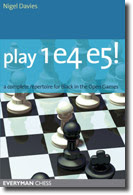
Play 1 e4 e5!
A Complete Repertoire For Black In The Open Games

By GM Nigel Davies
Everyman Chess

In the introduction, Nigel Davies explains his reasoning behind taking up 1...e5, the most classical reply to White’s most popular opening move. He explains how he himself switched from his former favourite Pirc/Modern complex when Lev Psakhis told him that the study of the Ruy Lopez was essential to developing the game of any chess player, and that the great Polugaevsky lacked such a grounding and therefore suffered due to the lack of it.

He is right when he says the average club player is put off defending 1...e5 by the shear amount of options open to White, from the Ruy Lopez to all the old gambits.

In fact, the old gambits have all been defused by modern theory and well-versed Black players should be delighted to see them appear over the board. The biggest problem must surely be how to tackle the Ruy Lopez and I was intrigued to see which line Davies would recommend.

Just over half of the 192 pages are devoted to the Lopez. The recommended repertoire focuses on the Closed Lopez in general and specifically the Keres Variation.

This goes:

1 e4 e5 3 Nf3 Nc6 3 Bb5 a6 4 Ba4 Nf6 5 0-0 Be7 6 Re1 b5 7 Bb3 d6 8 c3 0-0 9 h3 Na5 10 Bc2 c5 11 d4 Nd7


Keres prepared the idea for the 1962 Curacao tournament. It has some advantages and disadvantages over other lines. For example, by defending e5 with the Knight, the Black Queen is given more freedom in comparison with the variations when she slips to c7 and the Bishop can go to f6 to apply more pressure to the very important d4 point. One downside would be the lack of control over certain White squares - namely f5 and d5 - which could be useful targets for a White Knight.

I think that this is possibly the major selling point of the book. Two famous 1...e5 repertoire books have covered everything except the Ruy Lopez (‘Understanding the Open Games’ by Soltis, Mednis et al and ‘Play The Open Games As Black’ by John Emms). They are both excellent books but it is clearly more appealing to have an all-inclusive repertoire in a single book.

The illustrative games are well chosen and show the likes of Ponomariov, Graf and Keres defending the Black side of the debate. There are several games by Davies himself, which is a good thing, because I firmly believe that chess authors should practice what they preach.
There are five chapters on the Ruy Lopez. In addition to covering the Keres Variation, Davies recommends line against the early White deviations such as the DERLD and the Exchange Variation. Never heard of the DERLD? It’s an acronym for the Delayed Exchange Ruy Lopez Deferred, which players of a certain age may remember being enthusiastically touted in a Len Pickett monograph.


The Exchange Variation will put many players off 1...e5, at least as a winning attempt. Davies tries to pep things up for Black with 5...Qf6, which leads to more unusual paths than the main lines and has been holding up well in Grandmaster play.


Of course the author doesn’t claim to be able to gain an advantage as Black but he does supply enough ammunition to be able the studious reader to battle against the ‘Spanish Torture’.
The second half of the book deals with all of the other White options.

The combative Two Knights’ Defence is given good coverage, though in it’s more usual form and not the ultra-sharp Traxler variation.

9 Nh3!?, championed by Steinitz, Fischer and Short, is roughed up by 9...g5!? in a game Grischuk -Malaniuk…


…in which White could find nothing better than rerouting the Knight to f3 via g1 on moves 12 and 13.

Following a chapter on the popular Scotch game, the book rounds off with chapters on White’s other second and third move options. I was a bit surprised to see 2 …Bc5 recommended against the King’s Gambit as I always thought White gained a pleasant edge in the ensuing variations. However, the main illustrative game is once again one of the author’s own, so it is clearly a line he his happy with.

VERDICT: An all-encompassing 1 e4 e5 book is a rare beast indeed. This has the advantage on previous works of giving the Ruy Lopez full coverage. The lines given certainly look good enough to make up a repertoire but I would recommend a bit more background reading on the early deviations to go with it. On the whole, if you fancy a change for the New Year, you could do a lot worse than give this book a try.

For details of Everyman chess books, please visit:
http://www.everymanchess.com/


Happy reading!
December 2005

Archive: UNCUT! 44

The Sean Marsh Chess Column
UNCUT!
*Column 44*
* *December 2005* *

Make A Wish….
A Cautionary Tale For The Festive Season


The three passengers looked up as the old man boarded the train and sat down opposite them. After a short time he produced a deck of cards and began shuffling them. He allowed one to fall to the floor and as one of the other passengers bent down to pick it up he noticed the face of the card depicted a chess problem.

‘Oh - chess!’ he exclaimed. ‘I play a bit myself. These cards look interesting.’

He other two men were also chess players and now the ice was broken they began discussing the greatest of all games. The old man had thus far remained silent but when the conversation lulled he sat up sharply to attract attention.

‘With these chess problems I can determine your futures’ said the old man. The three passengers looked at him in surprise but his countenance remained staid; it was clear that the old man sincerely believed what he said to be true.

‘Er…how, exactly?’ ventured the first passenger.

‘Well’, he replied, ‘Come closer and I shall tell you…’

The men did as they were bid. ‘Tell me what you desire’ said the old man, tapping his ancient finger on the top of the pile of chess problems.

The first passenger leaned closer still. ‘Ok, I’m not afraid to try’ he bravely said. ‘I have the overwhelming desire to be successful in my next weekend congress. In fact, that’s where I’m going now. Ever since I started playing in these events I’ve never been able to take first prize. Second, every now and then; third more often…but never first! That is my burning ambition.’

‘So you seek the ultimate weekend…so be it.’ With this, the old man tapped the cards again and then with surprising dexterity, began shuffling the pack before quickly sliding out a card and placing it, face down, on the table.

‘A word of caution, my friend…if you solve the problem, all that you desire will be yours. If you fail…’ here he left his sentence unfinished but stared the man full in the face. It was decision time. The man thought for a little while and then broke into a grin. ‘

Ok, I’ll do it! Just show me the problem and give it a go.’ The old man turned the card around to reveal the following position…


White to play and mate in four moves


As the man sat there, engrossed in the chess problem, the train rumbled on.

The second man leaned forward. ‘May I try?’

‘But of course’, came the cool reply. ‘And what is your desire?’

‘Well, there’s this girl…’

The old man smiled. Ah yes, there is always a girl…

‘She’s not a chess player and she thinks I spend far more time on the game than I do on her. She is in fact an artist, with her own studio in town. Her speciality is painting animals, especially birds. Blackbirds, robins, starlings…the likenesses are incredible and her style has an almost mesmeric quality. Sometimes I go to the studio and spend hours just staring at her tits. I want to spend forever with her but have time for chess as well. My desire is for her to see my side of the story and be more accommodating. Surely she can see that chess means just as much to me as she does and accept the fact?’

The old man said nothing but merely dealt a card. The man stared at the chess problem and the world around him melted away…

White to play and mate in three moves


Still the train moved on down the line. The third man looked at his two fellow passengers, oblivious to their surroundings, and felt left out. Driven by the paranoia that haunts all chess players, he wanted to be part of the experience and asked the old man if he could try a problem.

‘My desire is simply to improve my playing strength a little. There’s a guy down at the club who always seems to beat me and it would be great to think I could get the better of Mr Kwan some time.’

The old man looked up. ‘Ah - your friend is of the Oriental persuasion?’

‘He wouldn’t need much persuading; he’s Chinese.’

‘So be it,’ said the old man, ‘Here is your challenge,’ and he flipped over another card from his deck.


White to play and mate in three moves

After a while, each man in turn decided the problems were beyond them. Shortly afterwards they had to disembark but as they turned to say goodbye to the old man, they found he was no longer there….

The first man’s weekend turned out to be the worst of his life. With the unsolved chess problem occupying all of his thoughts, he lost his Friday night game by a hideous blunder. Then he misread his hotel instructions and ended up on the same floor as a Doctor Who Convention. Waking up in the middle of the night, he was shocked to see his room full of silver-clad robot look-alikes. One of them was leaning over him with a strange device in his hand. The last words the man heard before he passed out were: ‘Activate the magnetron!’

The second man got off the train and set off to see the woman in the shop. Unfortunately, he decided to call in at the local chess club first and when he finally went around to see her it was too late - she had left. For good. The bird had flown…

The third man failed to spot the chink in the defence of the Black King and, like his fellow travellers, gave up on the chess problem. Never in his life did he ever beat his club-mate.
All three had been guilty of the same mistakes and their lives were never the same again.

And what of you, dear reader? Dare you take a card and stake your future upon it?
So be it! Once you have solved the three problems above, then here is a special bonus one, just for you.

And don’t forget - be careful what you wish for!


White to play and mate in two moves

Answers in the New Year…if you are still around! Mwahahahahahahahah!


Sean Marsh
13/12/2005